Most advice about gaining YouTube subscribers starts in the wrong place. It tells creators to post more, chase trends, or beg for subs at the end of every upload, then acts surprised when the channel still stalls. The harder truth is that subscriber growth usually breaks at one bottleneck, and if you don’t diagnose that bottleneck, more uploads just create more noise.
The cleaner way to think about it is conversion. Views matter, but only if they turn into the next step, which is a subscribe, a return visit, or a binge on another video. On YouTube’s scale, that matters even more because the platform has over 2.5 billion monthly active users and users watch more than a billion hours of video every day (Cross River Therapy research summary).
Table of Contents
- Why More Views Don’t Always Mean More Subscribers
- Diagnosing Your Channel’s Growth Bottleneck
- Optimizing Thumbnails and Titles for Maximum Clicks
- Building a Funnel with Shorts and Long-Form Content
- Boosting Retention and Watch Time to Convert Viewers
- Crafting CTAs and End Screens That Drive Subscriptions
- Tracking Growth with a 14-Day Testing Framework
Why More Views Don’t Always Mean More Subscribers
A video can pull in views and still add very little to a channel. That usually means the content attracted the wrong audience, or it answered a passing curiosity without giving people a reason to subscribe. The clearest signal is subs per 1,000 views, because it shows whether attention turns into subscribers.
That is the metric to check when a channel looks active but growth stays flat. Two videos can bring in similar traffic and produce very different subscriber results, which usually means the problem is conversion quality, not raw volume. A channel with fewer views but stronger subscriber conversion is often healthier than one chasing broad reach with weak intent.
Practical rule: if views rise and subscribers do not, do not celebrate the traffic. Check conversion efficiency before changing the upload strategy.
Early growth is slow for a reason. A widely cited benchmark says the first 1,000 subscribers typically take 4 to 12 months for creators who post consistently, while the first 100 subscribers often arrive in 1 to 3 months and the first 10,000 subscribers commonly take 12 to 24 months (Heist Brain benchmark). The early curve moves slowly because the channel is still figuring out what converts.
The same benchmark puts numbers on what comes after that slow start. In the 1K to 10K band it reports monthly growth of 10% to 25%, tapering to 5% to 15% between 10K and 100K and 2% to 8% above 100K. Growth accelerates in that first band, but only if the channel has already built enough trust, clickability, and return visits for momentum to compound.
Diagnosing Your Channel’s Growth Bottleneck
Most creators waste time improving everything at once. They change the thumbnail, rewrite the title, cut the intro, switch topics, and add a louder CTA, then can’t tell what helped. A better approach is to isolate the single bottleneck and test one variable for a short window, usually around 14 days.
Start with the first visible leak
If impressions are coming in but clicks are weak, the packaging is the problem. That means the thumbnail and title aren’t creating enough curiosity or clarity for a stranger to open the video. If clicks are decent but viewers leave early, the issue is retention, not discoverability.
If the video holds attention but subscribers still don’t follow, the problem is conversion. The value proposition may be unclear, the channel page may not reinforce the promise, or the ask may come at the wrong moment. That’s the exact place where many otherwise good videos underperform.
A useful way to think about this is simple:
- Low impressions with decent clicks usually means the topic itself isn’t reaching enough people.
- Good impressions with weak clicks usually means the packaging is underpowered.
- Good clicks with weak retention usually means the opening or structure is losing viewers.
- Good retention with weak subscriber conversion usually means the offer to subscribe isn’t compelling enough.
Ask the right question before you touch anything
What changed on the last upload that could have affected the result, and what didn’t? If you can’t answer that, you changed too much.
Decision rule: fix packaging when the video isn’t getting clicked, fix the first 30 seconds when viewers leave early, and fix the subscription ask when the content works but the channel still doesn’t grow.
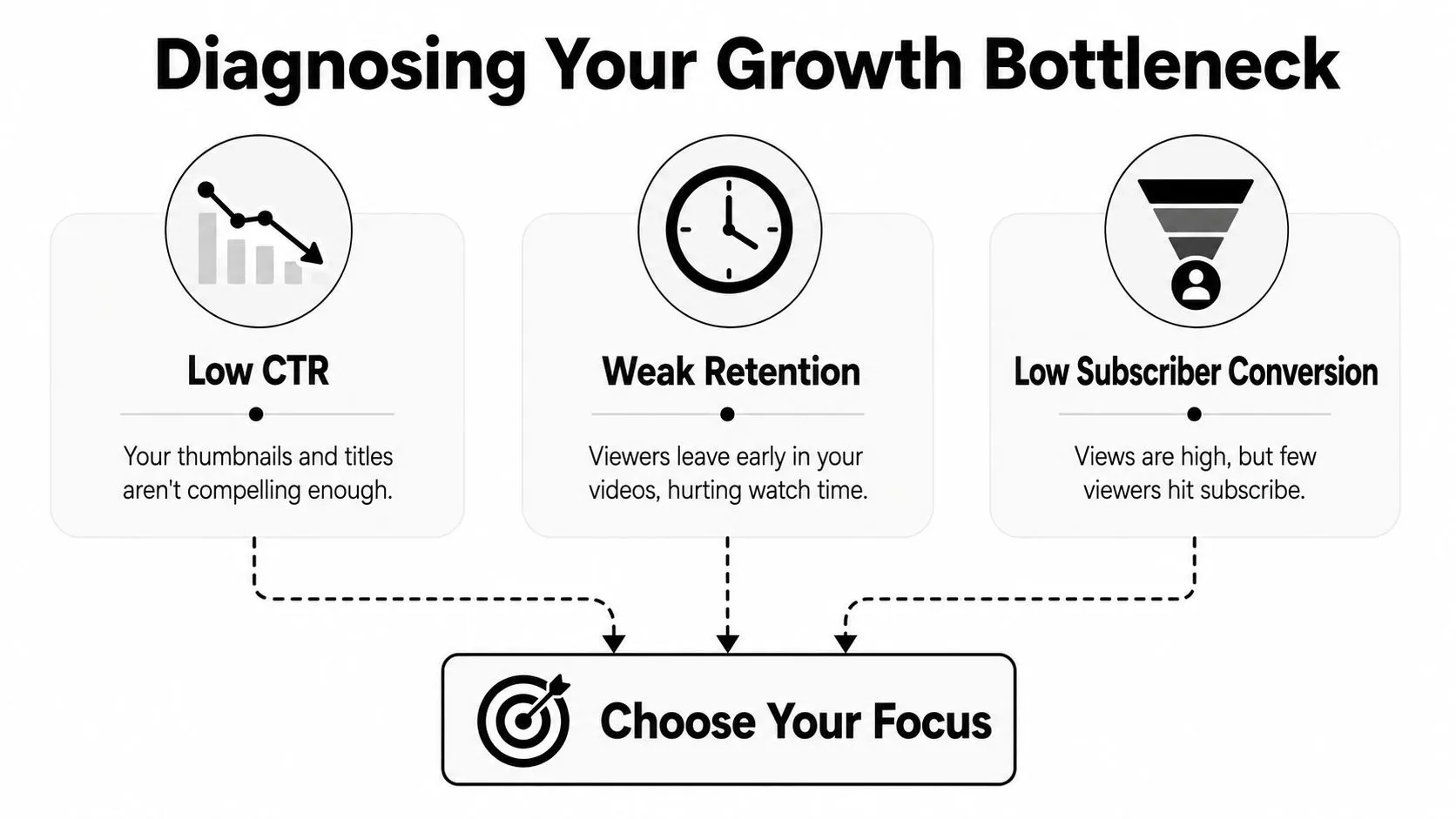
The best part of this framework is that it keeps you honest. Instead of guessing at “better content,” you’re reading the funnel one layer at a time and improving the exact point where people stop moving forward.
Optimizing Thumbnails and Titles for Maximum Clicks
Click-through rate starts before the video plays. If the thumbnail and title don’t create a sharp promise, the rest of the funnel never gets a chance to work. The goal isn’t decoration, it’s to make the offer instantly understandable on a crowded feed.
Packaging has to add information, not repeat itself
A common mistake is putting the same words in the thumbnail that already sit in the title. That wastes visual space and gives the viewer nothing new to process. Better thumbnails add a second layer of meaning, such as the outcome, the tension, or the contrast behind the title.
Contrast matters too. Clean backgrounds, one focal point, and a single strong idea usually beat cluttered compositions packed with too many objects or tiny labels. Mobile is where that discipline pays off, because over 70% of YouTube watch time comes from mobile devices (Cross River Therapy research summary). At that size the thumbnail has to do the heavy lifting fast, so the viewer should know what the video is about in a glance.
The title should carry the promise, not bury it in vague language. “Tips,” “tricks,” and generic phrasing make it harder for viewers to know why they should care. Clear outcome-driven phrasing usually wins because it reduces friction.
For a deeper breakdown of clickability, the internal guide on what makes a good YouTube click-through rate is a useful companion read.
Testing matters more than taste
That’s where tools help. Thumbo AI turns a plain-English video idea into ready-to-publish thumbnail variants using a Style Pack, then takes plain-English edits like “make my face bigger” on top of them, which is useful when the channel needs a cleaner visual system rather than another round of guesswork. Use it to make iteration cheap, not as a shortcut around judgment.
A thumbnail usually fails for one of three reasons. It tries to say too much, it doesn’t create contrast, or it doesn’t fit the emotional tone of the video. The fix is rarely a complete redesign. Most of the time, you’re simplifying the idea until the offer is obvious.
Strong packaging doesn’t make a weak video strong. It makes a strong video visible.
The smartest move is to treat thumbnails and titles as a pair, then test one change at a time. If the thumbnail changes but the title also changes, you won’t know which one affected the click.
Building a Funnel with Shorts and Long-Form Content
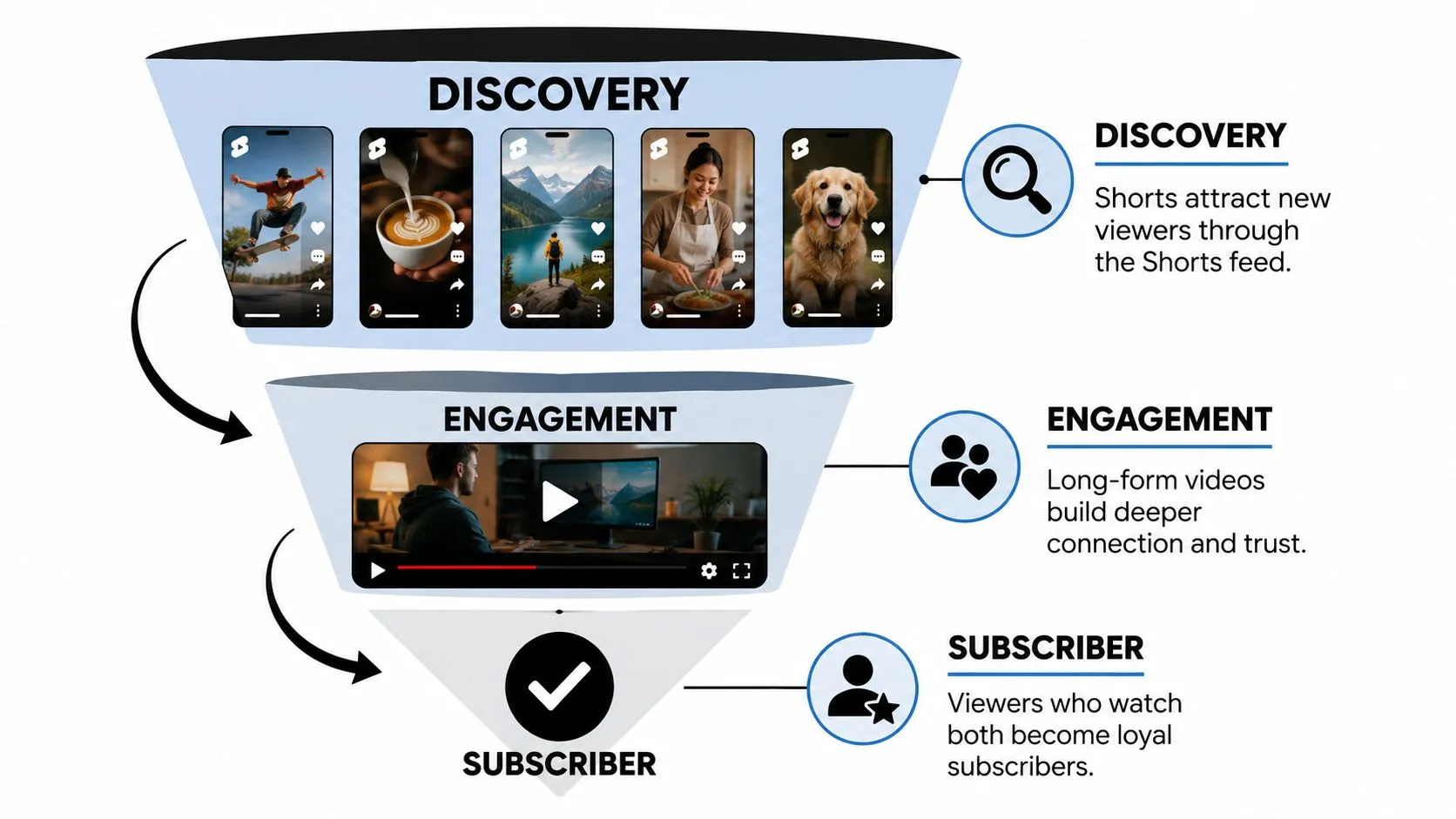
Shorts and long-form videos should not compete for the same job. Shorts handle discovery, long-form builds trust, and subscriber growth improves when each format is assigned a clear role. That split matters because Shorts are distributed through the Shorts Feed to viewers who do not already subscribe, which is why the Heist Brain benchmark treats them as a discovery engine: it reports that a single Short reaching 100,000 views can bring in 500 to 2,000 new subscribers, but only when the channel page is set up to convert the people it sends there.
Route attention, don’t leave it stranded
A Short has one job, earn curiosity and move the viewer to a related long video, playlist, or channel page. If the clip ends without a next step, it creates reach without momentum. Pinned comments and end screens solve that problem by giving the viewer a clear path instead of an empty exit.
The long-form video has a different job. It needs to deepen the relationship, show the creator’s point of view, and give viewers a reason to come back for more than one clip. Channels that grow steadily usually feel organized for that reason, not random, because each upload supports the next one.
The channel page carries the same weight. Organized playlists, a short trailer, and a clear homepage layout help new visitors understand what subscribing gives them. A visitor who can immediately see the next few useful videos is more likely to keep exploring.
Use cadence as part of the funnel
Consistency helps the funnel work because YouTube has more chances to understand the channel and viewers have more chances to recognize the pattern. The clearest evidence is the gap between the two timelines in the Heist Brain benchmark: creators posting weekly long-form typically need 4 to 12 months to reach 1,000 subscribers, while creators who also post Shorts can get there in 2 to 6 months. It also names niche consistency as the constraint on both, with the algorithm needing a channel to stay in one lane for 6 months or more before it learns what to recommend.
That is not an argument for volume on its own. It shows that discovery content works better when it feeds deeper content on a steady schedule, which is why combining the two formats beats picking one.
For workflow ideas and formatting, how to create a YouTube Short fits naturally with this approach.
Boosting Retention and Watch Time to Convert Viewers
Retaining viewers isn’t about keeping everyone watching forever. It’s about keeping the right viewer engaged long enough to trust the channel. If the opening makes a promise and the body delivers it cleanly, subscribers are far more likely to follow.
The first 30 seconds decide a lot
The opening has to confirm the payoff quickly. Don’t spend the first minute clearing your throat with branding, filler, or a slow setup that delays the actual value. Viewers arrived because of the title and thumbnail, so the video has to pay that off fast.
A good structure gives people a reason to stay. Start with the outcome, move into the steps, and cut anything that doesn’t support the point. That’s especially important on channels where the viewer may not know the creator yet.
Retention graphs are useful because they show where the promise breaks. A sharp drop right after the intro usually means the setup took too long or the pacing felt disconnected from the packaging. A later dip often means the video drifted away from the topic the title sold.
Structure should match viewer expectations
You don’t need theatrical editing to improve retention. You need fewer dead spots. Many videos lose people because the creator explains the context longer than the viewer needs or repeats the same idea twice.
A simple storytelling principle helps here. Each segment should answer one question and create the next. When the video feels like a chain of useful moments, viewers keep moving because they can see progress.
The connection to subscribers is direct. If viewers feel the channel consistently respects their time, they’re more likely to return. That’s the difference between a one-off video and a channel they start to trust.
Crafting CTAs and End Screens That Drive Subscriptions
A bad subscribe ask sounds generic and arrives too early. A good one fits the moment, reflects the viewer’s intent, and gives them a reason to take the next step. The subscription ask should feel like a logical extension of the value they just got.
Ask after value, not before it
If the viewer hasn’t yet seen a payoff, a CTA can feel premature. The channel earns more trust when the ask comes after a useful result, a solved problem, or a clear insight. That’s why the end of the video often works better than the first minute for conversion.
The wording should be specific. Instead of “subscribe for more,” tie the ask to the channel promise or the next useful outcome. Viewers respond better when they know what kind of future content they’ll get.
Make the end screen a route, not a dead end
End screens work best when they continue the viewer’s journey. One clear next video, one related playlist, or one channel trailer can keep the session alive. Too many choices create friction, and friction kills momentum.
A channel trailer can help here if it’s short and clear. The best ones quickly answer who the channel is for and why a visitor should subscribe. Organized playlists do the same job by turning individual videos into a path instead of isolated pieces.
If you’re using a trailer, keep it tight and focused. If you’re using playlists, name them around viewer outcomes rather than broad categories. The subscriber is choosing a future experience, not just a library.
Tracking Growth with a 14-Day Testing Framework
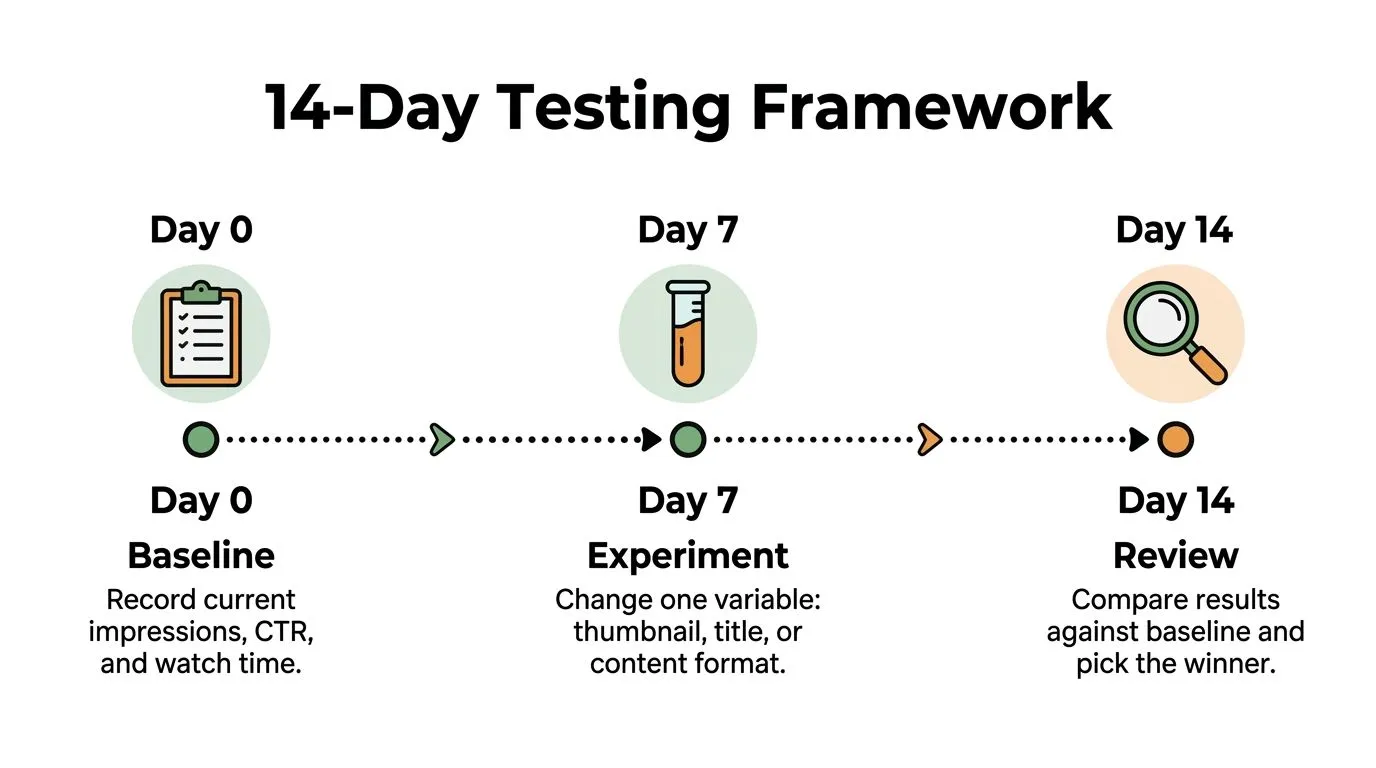
A 14-day window is long enough to see a pattern and short enough to keep you from guessing. The job is to isolate one variable, hold the rest steady, and compare the result against a clean baseline. If you change several things at once, you lose the ability to tell what moved subscriber growth.
A practical cycle looks like this
Day 0, record your baseline, impressions, clicks, average view duration, and subs per 1,000 views. Day 7, change one variable only, maybe the thumbnail, title, intro structure, or CTA. Day 14, compare the results and keep the stronger version.
That discipline keeps a channel from turning into a pile of random tests. It also makes the next decision easier because you are comparing real signals instead of memory or preference.
If packaging is the question, start with the guide on how to get your YouTube videos more views and use it as input for the next test.
What to watch, and what to ignore
Start with the bottleneck metric. If clicks improved, packaging probably moved in the right direction. If clicks stayed flat but retention improved, the opening got better, but the packaging still needs work.
The main mistake is changing the topic, the thumbnail, and the intro all at once. That creates motion without learning. The channel grows faster when you know which lever moved the result, because then you can repeat the right fix instead of guessing.
A creator who uses this rhythm does not need to speculate as much. Each 14-day cycle gives a cleaner read on what viewers respond to, and that is how a channel starts compounding instead of drifting.
If packaging is the bottleneck you keep landing on, Thumbo AI makes the thumbnail half of each test cheap to run, turning a video idea into publishable variants in a Style Pack and letting you adjust them in plain English. Use it when the next 14-day cycle depends on getting a stronger thumbnail in front of viewers, not on waiting for inspiration.