Creators can start making money on YouTube at 500 subscribers if they also have 3 public uploads in the last 90 days and either 3,000 public watch hours in the last 12 months or 3 million Shorts views in the last 90 days. Full ad revenue through the YouTube Partner Program still requires 1,000 subscribers plus either 4,000 watch hours in 12 months or 10 million Shorts views in 90 days.
Most advice on this topic gets the order wrong. Subscriber count is not the finish line, it’s only one gate in a monetization system that also cares about watch time, Shorts performance, and recent upload activity.
Table of Contents
- Why Subscriber Count Alone Does Not Determine Your Income
- YouTube Partner Program Eligibility Tiers Explained
- What Drives YouTube Revenue Beyond Subscribers
- How to Reach 500 and 1000 Subscribers Faster
- Alternative Monetization Paths Before and Beyond YPP
- Realistic Earnings Expectations at Different Subscriber Levels
- Common Questions About YouTube Monetization Thresholds
Why Subscriber Count Alone Does Not Determine Your Income
A lot of creators ask how many YouTube subscribers to make money because subscriber count feels like the cleanest milestone. It isn’t. YouTube’s monetization is a gate system, and the gate you pass depends on what kind of revenue you want, not just how big the channel looks on paper.
Eligibility and earnings are different problems
The biggest misconception is that subscribers directly pay you. They don’t. Earnings come from monetized views, viewer behavior, ad demand, and the type of content you publish, while subscribers mainly tell YouTube whether you qualify for certain features.
That’s why a smaller channel can sometimes earn more than a larger one. A niche with strong advertiser demand can outperform a broad entertainment channel if the audience is more valuable to advertisers and the videos hold attention longer. YouTube’s own monetization structure makes that separation obvious, since it asks for both audience size and viewing activity before it opens the door.
Practical rule: if you want income, chase watch time, audience fit, and repeat viewing first. Subscriber count is the checkpoint, not the paycheck.
The best way to think about it is this. Subscribers help you enter the system, but the system pays based on what viewers do after they click. A channel with loyal viewers, longer sessions, and a strong niche can build meaningful revenue earlier than a channel that looks bigger but doesn’t convert attention into monetizable viewing.
That’s why “more subscribers” is too simple an answer. It ignores the economics of your topic, the strength of your thumbnails, the quality of your retention, and whether advertisers want your audience in the first place.
YouTube Partner Program Eligibility Tiers Explained
YouTube now uses tiered eligibility, not one fixed threshold. That shift matters because it moved the conversation from “get to 1,000 subscribers or nothing” to a ladder with different entry points for different monetization tools. YouTube’s own page for the expanded Partner Program sets out both rungs and is the place to check the live rules, including the country list, since the lower tier is only open to creators based in eligible countries.
The two milestones creators need
At 500 subscribers, creators can qualify for some fan-funding and commerce features if they also have 3 valid public uploads in the last 90 days and either 3,000 valid public watch hours in the last 12 months or 3 million valid public Shorts views in the last 90 days. That tier opens the door to tools like memberships and shopping-related features, which can matter a lot for smaller channels with a loyal audience.
At 1,000 subscribers, the channel can move toward full ad-revenue eligibility, but it still has to meet one of the viewing requirements. The standard path is 4,000 public watch hours in the last 12 months, or the Shorts alternative of 10 million views in 90 days. That is the milestone many creators mean when they talk about “making money on YouTube,” even though it is really the milestone for ad monetization.
| Tier | Subscribers | Watch Hours or Shorts Views | Upload Requirement | Features Unlocked |
|---|---|---|---|---|
| Fan-funding and commerce entry | 500 | 3,000 watch hours in 12 months or 3 million Shorts views in 90 days | 3 public uploads in 90 days | memberships, shopping-linked features, other early monetization tools |
| Full ad-revenue path | 1,000 | 4,000 watch hours in 12 months or 10 million Shorts views in 90 days | No separate upload minimum | YouTube Partner Program ad revenue |
For application details and common setup mistakes, the practical walkthrough in this monetization guide is worth checking alongside YouTube’s own policy page.
The important takeaway is that YouTube does not treat all monetization the same way. A channel can begin earning in smaller ways before it qualifies for ads, and that helps creators who are building steadily instead of chasing a single big threshold.
What Drives YouTube Revenue Beyond Subscribers
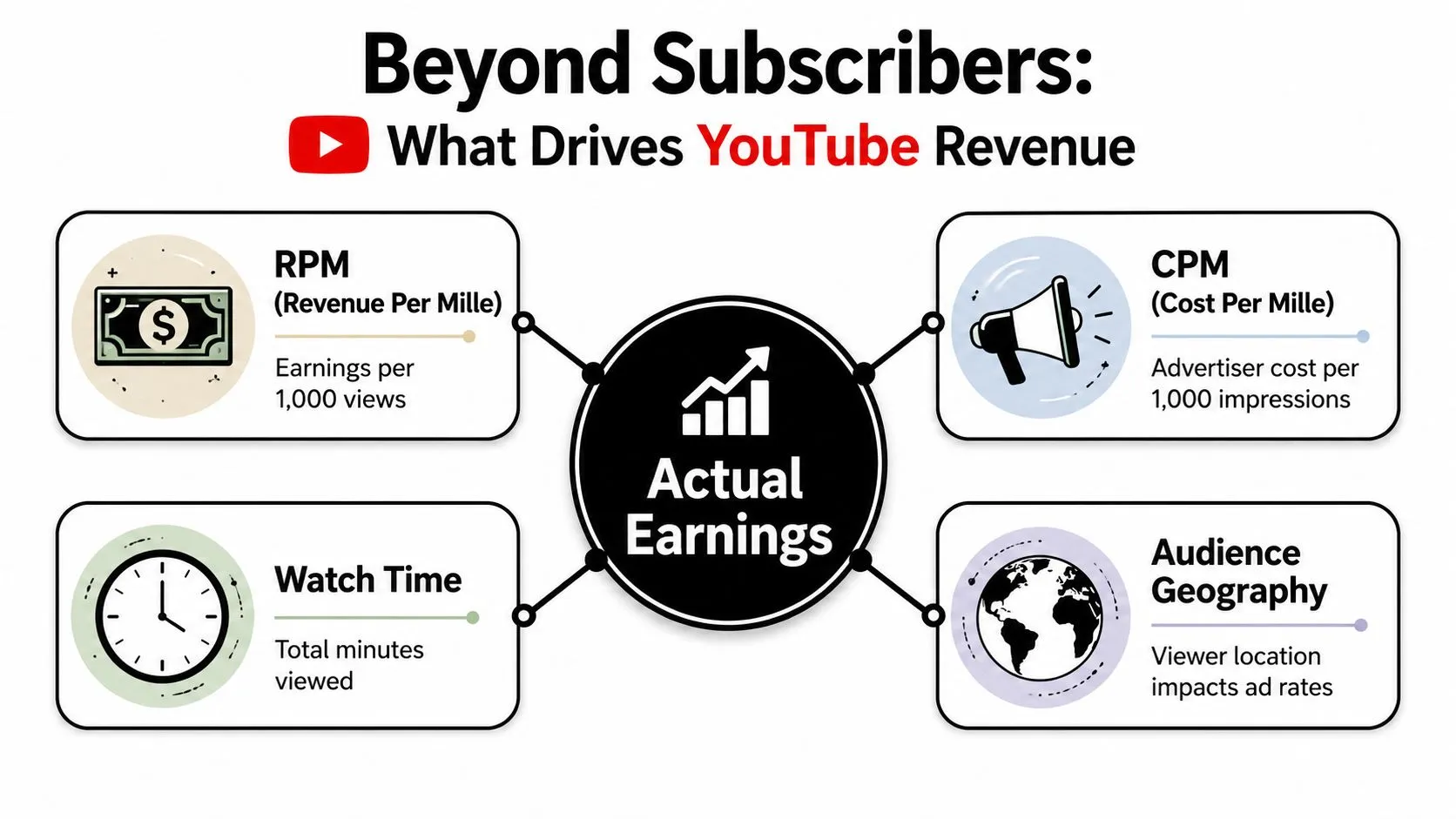
Subscriber count tells you how large the subscribed audience is. It does not tell you how much money a video will make. Revenue depends on what happens inside each viewing session, which is why two channels with similar subscriber counts can earn very different amounts.
RPM, CPM, and niche value
The most useful money metric for creators is RPM, which is revenue per thousand views. CPM is the advertiser’s cost per thousand impressions. Those are not the same thing, and creators often blur them together when they should be thinking about how much each view is worth after YouTube’s cut.
Finance, software, and business channels often earn more per view than entertainment channels because advertisers usually value those audiences more highly. That does not mean those niches are easier. It means the audience is more likely to attract premium bids, which changes the economics of the whole channel.
Why engagement beats raw audience size
Watch time per impression matters because it signals that viewers are staying with the content, not just skipping away after the click. Click-through rate matters because a strong thumbnail and title package gets more people into the video in the first place. Audience geography matters too, since advertisers bid differently depending on who is watching.
A channel with fewer subscribers can still outperform a larger one if the viewers are a better fit for advertisers and stay longer once they click.
For creators comparing tools and terminology, this RPM breakdown is a useful companion to the idea that revenue is driven by views and viewer quality, not subscriber totals alone.
So when a channel feels “big” but money is thin, the problem usually is not the subscriber count. It is that the content does not hold attention well enough, or the audience is not valuable enough to advertisers, or both. That is the primary monetization gap most channels run into.
How to Reach 500 and 1000 Subscribers Faster
Growing to 500 and then 1,000 subscribers is much easier when the channel is built for clicks and retention from the start. The fastest gains usually come from videos that are easy to understand, easy to click, and easy to keep watching. That sounds simple, but most channels miss at least one of those three.
Thumbnails and titles do a lot of the heavy lifting
Thumbnail design matters because it affects the click before a viewer ever hears your idea. Clean subject framing, one clear focal point, and readable text placement beat cluttered designs almost every time. Strong contrast helps too, especially when the thumbnail has to stand out next to a busy recommended feed.
If you want a practical workflow for improving views, the tactics in this YouTube views guide line up well with what works on small channels. Test one variable at a time, not everything at once. If you change the topic, title, and thumbnail together, you won’t know what helped.
Use Shorts with intent. They’re useful for discovery and can bring in subscribers faster than long-form videos, but they don’t replace the long-form watch hours needed for the main monetization path. That means Shorts should support the channel, not become the whole strategy unless the Shorts-based path is the one you’re actively pursuing.
Build around repeatable content systems
Consistency helps when it’s tied to a format people recognize. A creator who publishes clear series content, follows a reliable posting rhythm, and keeps packaging tight has a much easier time converting viewers into subscribers than someone who uploads random topics with inconsistent presentation.
- Start with searchable topics: Pick problems, comparisons, or tutorials people already look for.
- Tighten the first 30 seconds: Cut the long intro, get to the point, and show the payoff early.
- Reuse winning structures: If one video format gets clicks and retention, make the next video feel familiar.
- Ask for subscription at the right moment: Do it after value lands, not before the viewer cares.
Practical rule: optimize for one thing first, usually the thumbnail. A weak thumbnail can bury a strong video before the algorithm even gets a fair look at it.
The creators who move fastest usually aren’t chasing tricks. They’re building a channel where every upload teaches the next upload how to perform better.
Alternative Monetization Paths Before and Beyond YPP
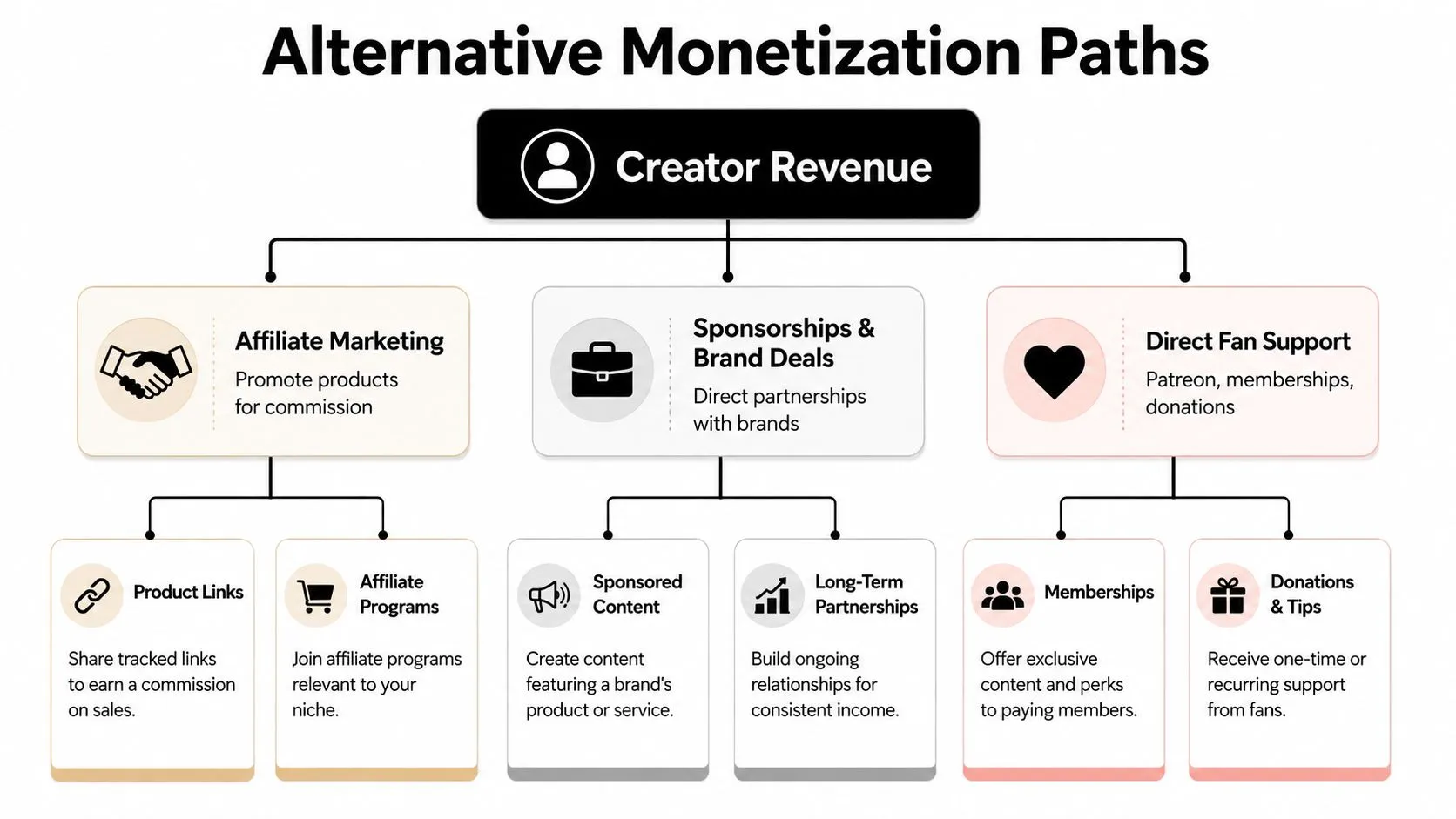
You do not need to wait for full ad monetization to start earning from a channel. Smaller creators often make money earlier through direct audience support, affiliate links, or services connected to the content. That matters because the YouTube Partner Program is only one part of the income mix.
Compare the paths by control and fit
Affiliate marketing fits channels that already recommend products, tools, or gear. It can sit naturally inside tutorials, reviews, and buying guides, which makes the offer feel relevant instead of forced. The trade-off is simple, the recommendation has to match the video closely or viewers will ignore it.
Sponsorships and brand deals usually depend more on channel clarity than raw subscriber totals. Brands need to understand who the audience is and why the channel matters to that audience. A focused niche often wins here because it gives brands a cleaner fit than a broad channel with mixed topics.
Direct fan support through memberships, Patreon, donations, or merchandise can work before ad monetization if viewers already feel connected to the creator. This path is strongest when the channel offers recurring value, community access, or a clear identity people want to support.
Some creators use thumbnail generation tools like Thumbo AI to speed up their workflow. If thumbnails are slowing you down, an AI thumbnail tool can build a thumbnail from a video you have already recorded or from a reference image, then let you adjust it by typing a note instead of opening an editor. That does not replace strategy, but it can make testing faster when you are refining packaging for a channel still working toward monetization.
The practical move is to combine methods instead of waiting for one perfect revenue stream. Ad revenue may arrive later, while affiliate income, fan support, or sponsored work can keep the channel moving before the main YPP thresholds are met.
Realistic Earnings Expectations at Different Subscriber Levels
Subscriber count is a rough proxy for channel size, not a clean income forecast. A small channel with strong views and a valuable niche can out-earn a larger one with weak retention or lower advertiser demand. That’s why earnings expectations make more sense when you think in terms of views and RPM, not just subscribers.
A practical way to think about income
There is no fixed rate per view, which is exactly why subscriber count cannot answer the income question. Shopify’s creator monetization guide makes the mechanics plain: raw view counts don’t translate directly to revenue because not every view generates an ad impression, and YouTube keeps 45% of long-form ad revenue and 55% on Shorts before anything reaches the creator. The same guide cites NeoReach’s 2025 Creator Earnings Report, a survey of more than 3,000 creators, which found 56.55% of full-time creators earn less than $44,000 a year, up from 48% in 2023, and that brand deals make up 49% of creator earnings on average. So the honest framing is that the same subscriber total can produce very different results depending on niche, engagement, and how many income streams the channel runs.
Practical rule: use subscribers to estimate reach, then use views and RPM to estimate income.
Here’s the honest version of what that means in day-to-day creator terms. A channel under 1,000 subscribers may earn little or nothing from ads, but it can still make money through other paths if the audience trusts the creator. A channel between 1,000 and 10,000 subscribers may start seeing meaningful ad revenue, but only if the views and niche support it. A channel between 10,000 and 100,000 subscribers can earn a lot more, though the actual range still swings widely based on topic and traffic quality.
What creators usually miss
Gross revenue isn’t take-home pay. Production costs, taxes, gear, software, travel, and edits all come out of the top line. That’s why creators should treat ad revenue as one input in a business model, not as the whole model.
If you want a realistic estimate, start with your average monthly views, then look at your niche’s monetization potential, then decide whether ads, affiliates, sponsors, or fan support are the best fit. That sequence is more useful than asking for a subscriber number as if it were a salary bracket.
Common Questions About YouTube Monetization Thresholds
A lot of edge cases come up once creators get close to monetization. Most of them boil down to the same issue, YouTube checks both eligibility and ongoing channel behavior, so the numbers only matter if the underlying activity stays valid.
What happens if subscribers drop after you qualify
Dipping back under a threshold is not itself listed as a reason YouTube removes monetization. The two removal triggers YouTube does document are inactivity and policy breaches: if a channel has not uploaded or posted for 6 months or more, YouTube reserves the right to remove its monetization, and channels lose monetization when they violate the channel monetization policies, which happens “regardless of their watch hours and subscriber count.” So the thing to protect is not the subscriber number, it’s the publishing rhythm and a clean policy record.
Do deleted or private videos still count
Every number in the published rules is qualified as valid public activity, whether that’s uploads, watch hours, or Shorts views, so private or deleted content isn’t something to rely on for qualification. That’s why it’s smart to think in terms of stable public inventory, not hidden backlog. If a video is doing the work, leave it public.
Do Shorts views replace everything
No. Shorts views can help you qualify through the Shorts-based path, but they don’t magically erase the rest of the system. You still need to satisfy the correct threshold for the feature you want, and the upload requirements still matter for the lower tier. Shorts are a useful entry point, not a universal shortcut.
If a monetization application gets rejected, fix the channel issue first, then reapply only when the public activity clearly meets the rule set.
Review timing can vary, and rejections usually point to a mismatch between the channel’s current status and what the application is asking for. The best response is to clean up the channel, check the public metrics, and make sure the content mix matches the path you’re applying for.
The bigger lesson is simple. Monetization is a process, not a badge. If you keep publishing, keep the channel public, and keep the monetization mix diversified, the thresholds become a lot less mysterious.
If you’re trying to turn thumbnails into clicks and clicks into monetization progress, Thumbo AI can help you build and refine thumbnail concepts faster. It fits this topic because the path to money on YouTube usually starts with better packaging, stronger retention, and more consistent testing. Visit it when you’re ready to make your next upload easier to click.