One number explains why so many creators misread YouTube Shorts monetization. In the creator economy, Shorts ad revenue sharing pays creators 45% of the allocated pool, while traditional long-form video pays 55%. That gap matters, but the bigger story is scale. Shorts now averages over 200 billion daily views, and the business around it is not small: Alphabet’s Q1 2026 results reported $9.883 billion in YouTube ads revenue for the quarter, and YouTube’s annual revenue passed $60 billion across ads and subscriptions in 2025, according to the 2026 statistics roundup at Teleprompter. Shorts is no longer a side feature, it’s part of the main ad system.
The mistake most creators make is treating Shorts like long-form video with a different format. The payout model doesn’t reward that mindset. It rewards volume, audience geography, niche demand, and whether you build more than one revenue stream around the same attention.
Table of Contents
- How YouTube Shorts Monetization Actually Works
- Meeting YouTube Partner Program Eligibility
- Realistic Earnings and RPM by Region
- Enabling Shorts Ad Revenue in YouTube Studio
- Maximizing Revenue Beyond Ad Sharing
- A Hybrid Funnel From Shorts to Long-Form
- Thumbnail Strategy for Shorts Growth
- Frequently Asked Questions About Shorts Earnings
How YouTube Shorts Monetization Actually Works
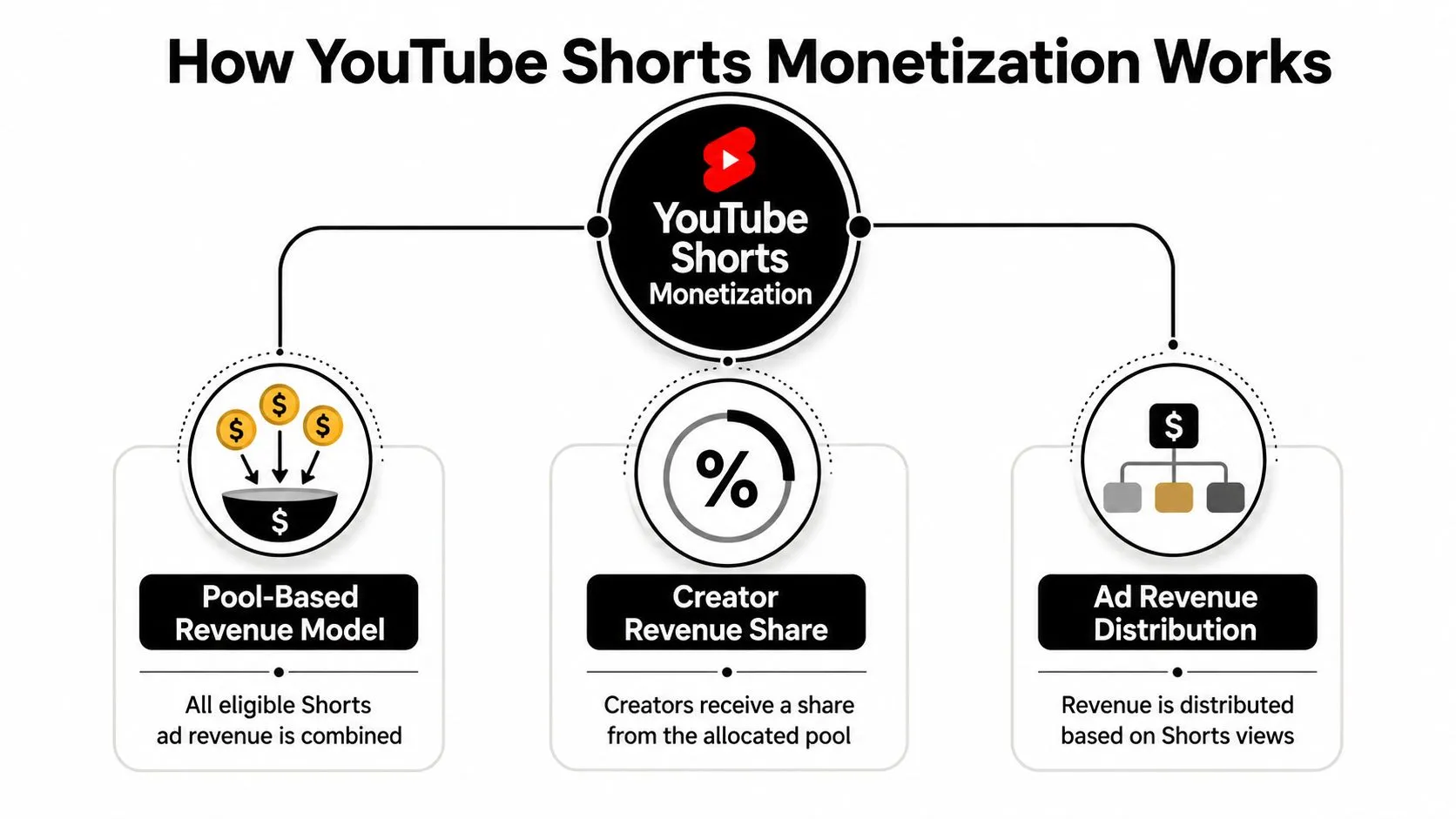
The model is pooled, not direct. YouTube collects ad revenue from ads that appear in the Shorts feed, removes music licensing costs when music is involved, then allocates the remainder into a creator pool and pays eligible creators 45% of that allocated revenue. That is the core difference from long-form video, where the split is 55% for creators.
Why the pool model changes creator behavior
A pooled system means your earnings depend on the whole monetized Shorts ecosystem, not just the ad shown after your clip. That’s why creators who obsess over a single viral view count often feel disappointed. The math is built around total participation in the feed, not a one-to-one ad impression attached to your video.
The practical shift is that Shorts monetization pushes creators toward repeatable volume, engaged audiences, and high-value geographies. A channel with consistent uploads and a clear niche can outperform a channel with occasional huge spikes, because the pool rewards dependable view generation and advertiser-friendly audience composition.
Practical rule: treat a Short as a unit of distribution, not a unit of income.
That shift also explains why the mechanics matter more than the milestone. Shorts revenue is a clear, official system rather than an experimental add-on: ad revenue from the Shorts Feed is pooled monthly, part of it covers music licensing, and the remainder is allocated to monetizing creators based on eligible engaged views, as set out in the Teleprompter statistics roundup. Once that is settled, creators stop asking whether Shorts are monetizable at all and start asking what kind of channel structure earns.
What this means in practice
If you build for raw views alone, you can still end up with thin earnings. If you build for repeat viewers, clear topic signals, and commercially useful audiences, the same Short can become part of a much larger revenue engine. That’s why Shorts monetization is best understood as a distribution layer inside YouTube’s ad stack, not as a simple pay-per-view machine.
Meeting YouTube Partner Program Eligibility
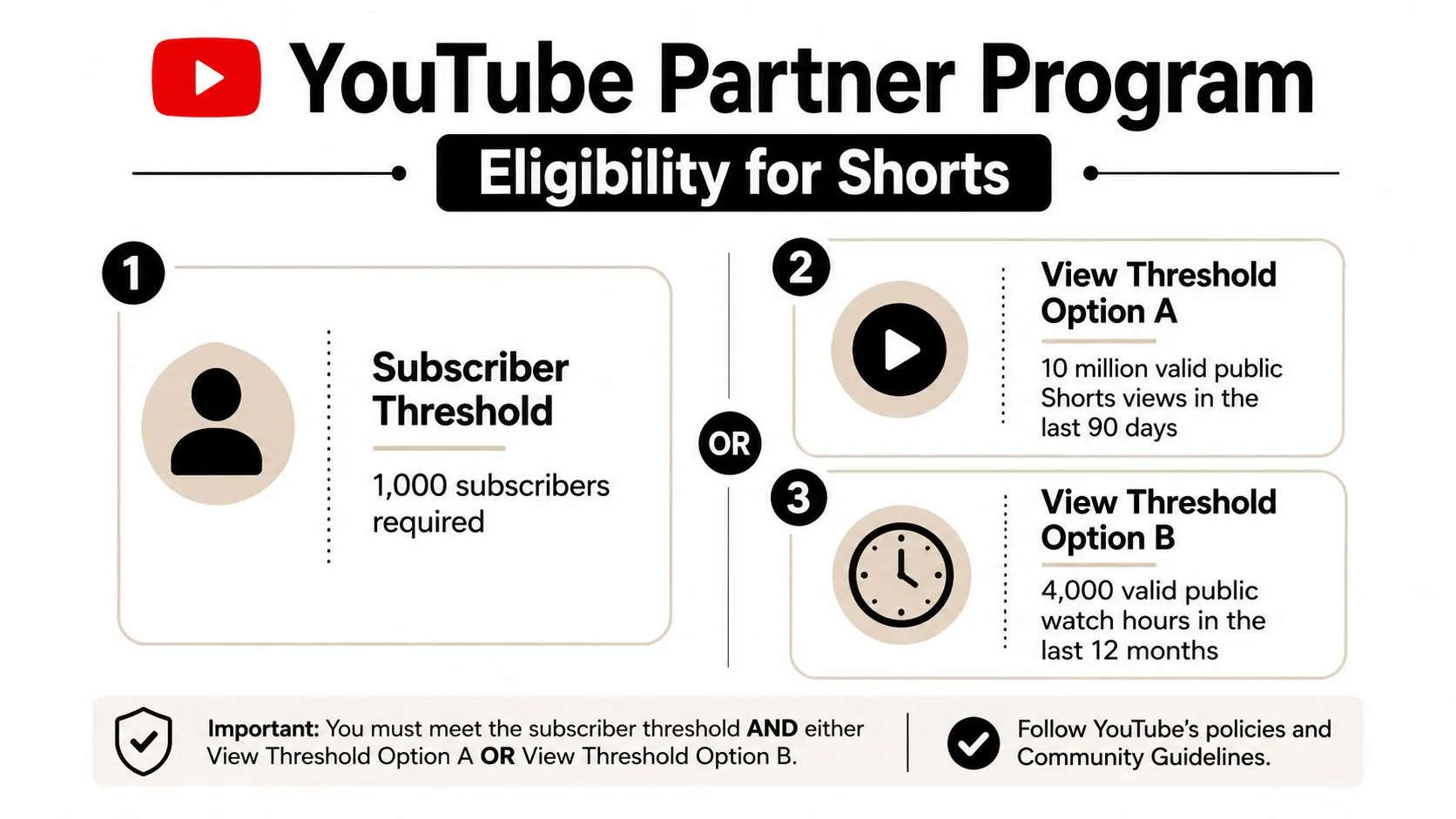
Shorts ad revenue starts with YouTube Partner Program access, and the thresholds are specific. For the ad-revenue path, creators need 1,000 subscribers plus either 10 million valid public Shorts views in the last 90 days or 4,000 valid public watch hours from long-form videos in the last 12 months, according to YouTube’s overview of the expanded Partner Program. Those are separate paths, not a combined requirement.
The lower tier matters too
YouTube also has a lower entry tier for fan-funding features. That path opens at 500 subscribers, 3 public uploads in 90 days, and either 3 million Shorts views or 3,000 watch hours. It doesn’t enable ad revenue, but it does give smaller channels a way to monetize before they hit the full Partner Program threshold, as described in YouTube’s eligibility documentation.
The detail that trips people up is that Shorts watch time does not count toward the 4,000-hour long-form requirement. If your channel is mostly Shorts, you’re not building toward the long-form route by accident. You’re building toward the Shorts view threshold, which means your metric is view velocity, not accumulated retention hours.
If your content is mostly vertical and fast-moving, optimize for reach and repeat impressions. Don’t chase watch-hour logic from long-form and expect it to transfer.
Which path fits your channel
Use this quick filter:
- Mostly Shorts, little long-form: push for 10 million valid Shorts views.
- Mixed format channel: build the subscriber base while using long-form to accumulate watch hours.
- Early-stage creator wanting fan-funding: aim first for the lower tier with 500 subscribers and the upload requirement.
If you want a procedural walkthrough of the application flow after eligibility, the setup steps are laid out clearly in this monetization application guide. The main thing to remember is that the threshold is only the gate. The revenue still has to be enabled manually after approval.
Realistic Earnings and RPM by Region
The number creators care about is usually smaller than they expect, and the clearest way to see why is YouTube’s own worked example. In it, ads running between Shorts in one country earn $100,000 in a month, music licensing takes a slice, and the Creator Pool lands at $90,000. A creator whose Shorts collected 1 million of that country’s 100 million engaged views is allocated 1% of the pool, or $900, and the 45% revenue share leaves $405, as laid out in YouTube’s Shorts monetization policies. Those are illustrative figures, not a rate card, but they show the shape of the thing: a million engaged views buys a share of a pool, not a fixed price per view.
Geography drives significant RPM variance
Country-level differences are wide enough to change the whole revenue picture, and they are built into the mechanism rather than bolted on. The Creator Pool is allocated by each creator’s share of total engaged views in each country, so earnings track what advertisers are spending against Shorts in the places your viewers actually live. Creators in lower-paying markets can still build strong channels, but the same view count can produce very different earnings depending on where the audience sits.
That is why Shorts revenue often feels inconsistent. Two channels can publish the same clip, pull similar views, and still land in different revenue bands because the viewer mix is different. Advertisers are not paying for a generic view. They are paying for the profile attached to that view.
The math explains why views alone disappoint
Run that example from the other direction and the lesson lands harder. A million engaged views returned a few hundred dollars in a month where the whole country pool was worth $90,000. Shrink the pool, split the audience across cheaper markets, or capture a smaller slice of the feed, and the same million views moves a long way down. That is the part many new creators miss. A million views sounds enormous, but a pooled share of it can still be a very small payout.
The practical lesson is simple. High view counts do not guarantee meaningful income if the niche and audience geography are weak.
For a clear explanation of how RPM works, see this RPM guide. Shorts revenue is real, but it is thin enough that ads alone rarely carry a channel unless the view volume is very high or the audience is worth more to advertisers. That is why creators who track Shorts over months usually pay as much attention to niche fit and audience location as they do to raw reach.
Enabling Shorts Ad Revenue in YouTube Studio
Eligibility doesn’t turn on earnings by itself. Once the channel meets the threshold, the creator still has to go into YouTube Studio, click Earn in the left menu, apply and accept the base terms, and then accept the Shorts Monetization Module as a separate step. That second step is the one creators skip, and it is expensive: Shorts views that accrue before you accept the module are not eligible for Shorts ad revenue sharing at all. Crossing a milestone does not switch the feature on.
The review process is usually tied to the application after the threshold is hit, and channels can be held back by content quality issues rather than the numbers alone. Reused clips, inactive channels, or policy problems are the common friction points creators run into when the application stalls.
What to check before applying
- Channel status: make sure there are no active Community Guidelines issues.
- Content originality: avoid reused or lightly transformed clips.
- Audience mix: confirm the channel is meeting the Shorts threshold with valid public views.
- Monetization settings: verify that the Shorts monetization module is turned on after approval.
You’ll also want to inspect the Analytics tab in YouTube Studio after monetization is live. Shorts revenue reporting is where you can tell whether your channel is benefiting from geography, niche, and repeat viewers, or just generating noisy reach with weak payout. The useful habit is not checking revenue once, but checking how it moves when you change the topic mix.
A lot of creators skip that part and blame the platform. In reality, the early report usually tells you whether the issue is content fit, audience location, or simple scale. If the channel’s numbers are weak, the fix isn’t always more uploads. Sometimes it’s better topic selection.
Maximizing Revenue Beyond Ad Sharing
Shorts ad revenue is the base layer, not the whole business. The creators who make meaningful income usually stack brand deals, affiliate links, merchandise, channel memberships, and Super Thanks on top of Shorts traffic. That matters because the ad pool can be too thin on its own, even when the views look impressive.
Which add-on fits which channel
Brand deals make the most sense in monetizable niches where sponsors already pay for attention. Affiliate marketing works best for tutorial-heavy content, especially when the viewer already has purchase intent. Merchandise fits audiences that care about identity and community, not just information. Super Thanks tends to work when viewers come back often and feel personally connected to the creator.
There’s also a niche-selection reality that many creators learn late. Niche-focused analysis of 2026 creator data puts finance, technology, and B2B education near the top of Shorts RPM, in the region of $0.15 to $0.45, while entertainment and gaming sit closer to $0.01 to $0.05. High views are not always high revenue. High intent usually wins.
Revenue stacking beats RPM chasing
- Tutorial content: sell affiliate products that solve the exact problem shown in the Short.
- Expert niches: pitch brands once the channel has clear topic authority.
- Identity-driven audiences: build merch around a recognizable viewpoint or community signal.
- Loyal repeat viewers: use Super Thanks and memberships as appreciation channels.
The cleanest channels are rarely the ones with the biggest viral spikes. They’re the ones with the clearest commercial fit. If a Short sends viewers to a useful product, a paid class, or a branded offer, the ad revenue becomes the smallest part of the total return.
A Hybrid Funnel From Shorts to Long-Form
A realistic Shorts strategy treats the format as discovery, then pushes viewers into something that earns better. A creator can post a Short, get a burst of attention, and use that attention to send people to a related long-form video, a playlist, a lead magnet, or a product page. That funnel is where Shorts start to look like an acquisition channel instead of a dead end.
A working channel structure
The channel page matters here. The Short should end with a hook that leads naturally into the next step, the channel page should group related videos together, and the long-form video should carry the deeper explanation and the stronger call to action. That setup creates continuity, which is what most short-form-only channels never build.
The difference shows up in the economics. Shorts can create broad reach, but long-form content usually monetizes better because the viewer spends longer with the channel and is easier to convert into a subscriber or buyer. Shorts bring people in, long-form gives them somewhere useful to go.
Working rule: use Shorts to earn attention, then use long-form to earn trust.
This is also where a creator stops measuring success only by the Short itself. The Short becomes successful if it feeds the rest of the channel. A clip that looks average on its own can still be valuable if it sends high-intent viewers into a playlist, a membership offer, or a digital product.
The short-form-only trap is simple to spot. Creators chase whatever spike the feed gives them, but they never build the second click. Without that second click, the channel keeps renting attention instead of owning an audience.
Thumbnail Strategy for Shorts Growth
Shorts do auto-play in the feed, but thumbnails still matter more than many creators realize. They show up on the channel page, in search, and in places where a viewer is deciding whether to click instead of scroll. That makes thumbnail design part of discovery, not decoration.
What actually improves click behavior
The best Shorts thumbnails are readable fast. Use high contrast, keep text to 3 to 4 words max, and give the viewer one obvious focal point. Faces that show emotion usually work because they create an instant human signal, but the key is clarity, not clutter.
Series recognition matters too. If your thumbnail style stays consistent across a Short and the related long-form video, viewers start recognizing the topic family before they read the title. That makes the channel feel organized, which helps when someone is browsing the channel page after a Short gets their attention.
A useful workflow is to create multiple thumbnail variants, then compare which one communicates the idea fastest. Tools built for thumbnail production make that process much less painful than editing each version manually. If you want a practical starting point, the workflow is covered in this Shorts thumbnail guide.
A simple thumbnail checklist
- One subject: keep the image focused on a single idea.
- Readable text: use short phrases, not sentences.
- Strong contrast: make the thumbnail easy to scan on a small screen.
- Consistent styling: reuse visual cues across a series.
The point is not to make every thumbnail loud. The point is to make it legible at a glance, because legibility is what helps Shorts convert from passive scrolling into intentional viewing.
Frequently Asked Questions About Shorts Earnings
When does Shorts revenue get paid out
Shorts ad revenue follows the same general YouTube payment cycle once the channel is fully monetized and Studio shows earnings. The key point is that monetization has to be active first, then the earnings still have to clear the usual payout requirements before any money is sent.
What happens if a Short uses copyrighted music
Music licensing costs come out of Shorts Feed ad revenue before the Creator Pool is calculated, so music use across the feed as a whole does shrink the pool everyone shares. What it does not do is penalize you specifically. YouTube states that each monetizing creator is allocated 100% of the engaged views on their Shorts regardless of whether music was used, so adding a track won’t change your allocation from the Creator Pool or your 45% revenue share rate.
Do embedded Shorts views count toward the 10 million threshold
Only valid public Shorts views count toward the Shorts eligibility path, and YouTube defines those narrowly: engaged views on Shorts you have set to public that appear in the Shorts Feed. Views on private, unlisted or deleted Shorts don’t count, and neither do ad campaigns or Image Posts that surface in the Shorts Feed. Track progress inside YouTube Studio rather than treating any external view counter as proof of eligibility.
What should a first-year creator expect
A practical first-year expectation is not “ad revenue replaces my income.” Shorts usually work best as the top of the funnel, building reach, subscriber growth, and proof of audience while the money comes from affiliate offers, sponsorships, memberships, or a long-form funnel.
If you want the blunt version, Shorts ad revenue alone is usually too thin to depend on. Channels that last build a stack, then let Shorts feed it.
If you’re building Shorts around a niche, a funnel, or a thumbnail system that can convert, use Thumbo AI to produce faster thumbnail variations and test what earns the click. It fits creators who want Shorts to drive real channel growth, not just empty view counts.